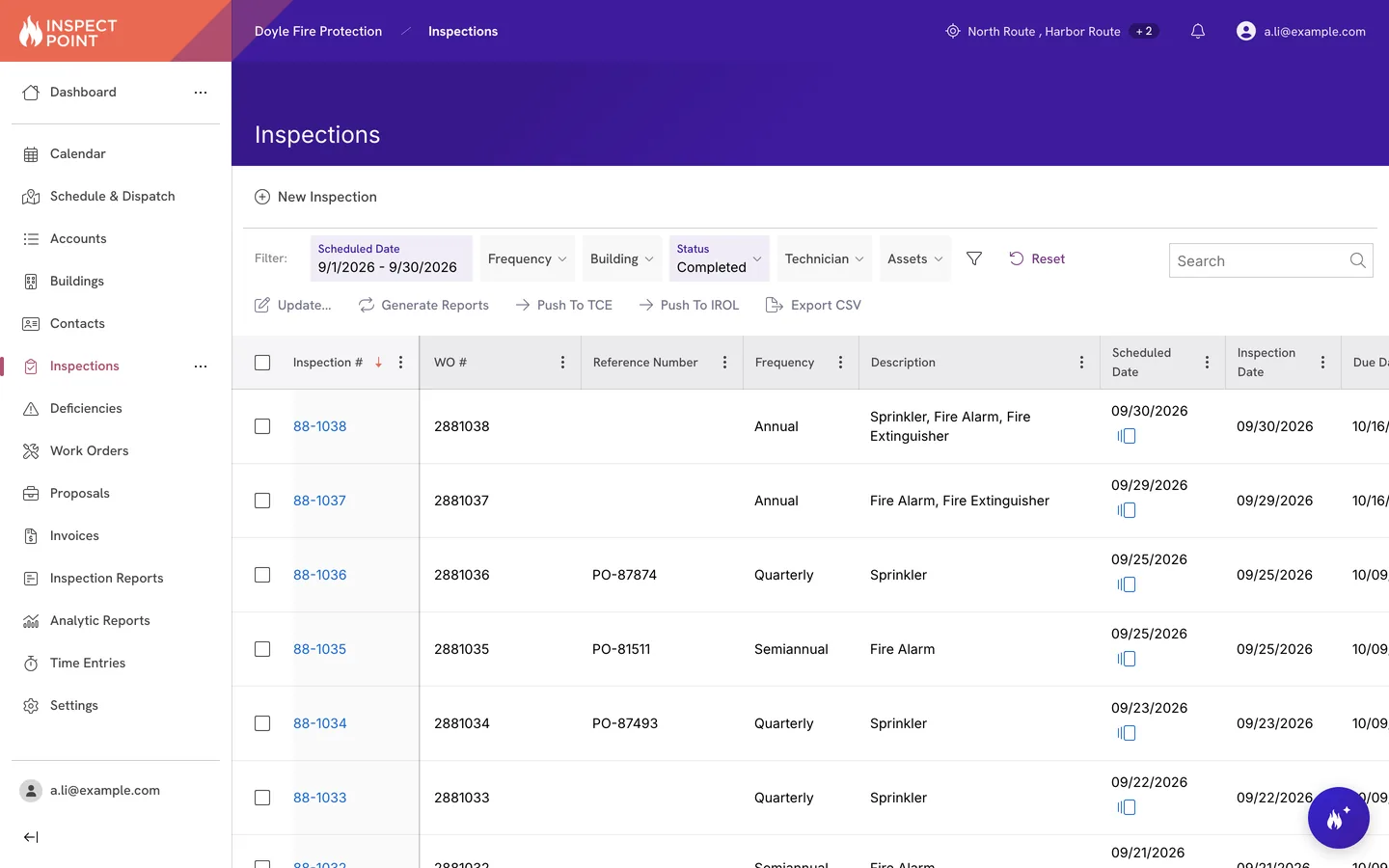
Buildings, contacts, systems, and assets move with you. Every branch’s records come in the same door, including the one you acquired last quarter.
Enterprise · 15+ technicians
Where North America’slargest fire protectionoperators run.
Multi-branch contractors and acquisition platforms run inspections, service, and compliance on Inspect Point every day, with 1,000+ technicians in the largest single deployments.
At scalePlatform totals
Inspect PointTroy, NY
Every acquisition is a standardization decision.
Whatever wins that decision becomes the playbook for the next branch, the next brand, and the next deal.
The multi-branch contractor
You grew into offices, territories, and divisions. Now the question every Monday is the same: is every branch inspecting to the same standard, or to whatever habits each office grew up with?
Multiple offices · multiple divisionsThe acquisition platform
You buy well-run local companies. Each one arrives with its own question sets, its own software, and its own definition of done. Every acquisition is a standardization decision.
Roll-ups · national accounts · PE-backed platformsWhat stays yoursEnterprise plan
Up to $4 in service revenue for every $1 of inspections.
60%
Margin strong operators earn on inspection and service work at scale
Test and inspection work carries the strongest margins in fire protection, and it is the side of the book that scales. Shift the work mix and the whole P&L follows: more inspections per tech, more deficiencies caught, more proposals accepted, faster cash.
Across the customer base
| Proposal acceptance | 2× |
|---|---|
| Faster field inspections | 67% |
| Service revenue per $1 inspected | Up to $4 |
| Invoices paid | $100M |
| Organizations in 2+ locations | 30 |
| With 100+ technicians | 8 |
| Expanded past first purchase | 49% |
“Inspect Point is very user-friendly and flexible to support the requirements within each of our offices and states.”
The move is the objection.
Nobody at your size is choosing software features. You are weighing the cost of the move. That is what the rollout is built for: crawl, walk, run, with each branch earning the next one, and your system of record kept in place.
Rollout3 phases
Implementation is built so your techs are inspecting in the platform early, not at the end of a six-month project plan.
The tenth branch runs the same way as the first, one at a time or all at once. Acquired companies onboard to your standard, on a schedule you control.
Two ways to lower the risk
Prove it on one division
Start with one division, prove the model, then onboard the rest on your own timeline.
Leave with your data
Buildings, contacts, systems, and assets come in at onboarding. If you ever leave, you take a full export with you.
One standard, everywhere you operate.
The common language across your branches is the inspection itself.
One workflow library
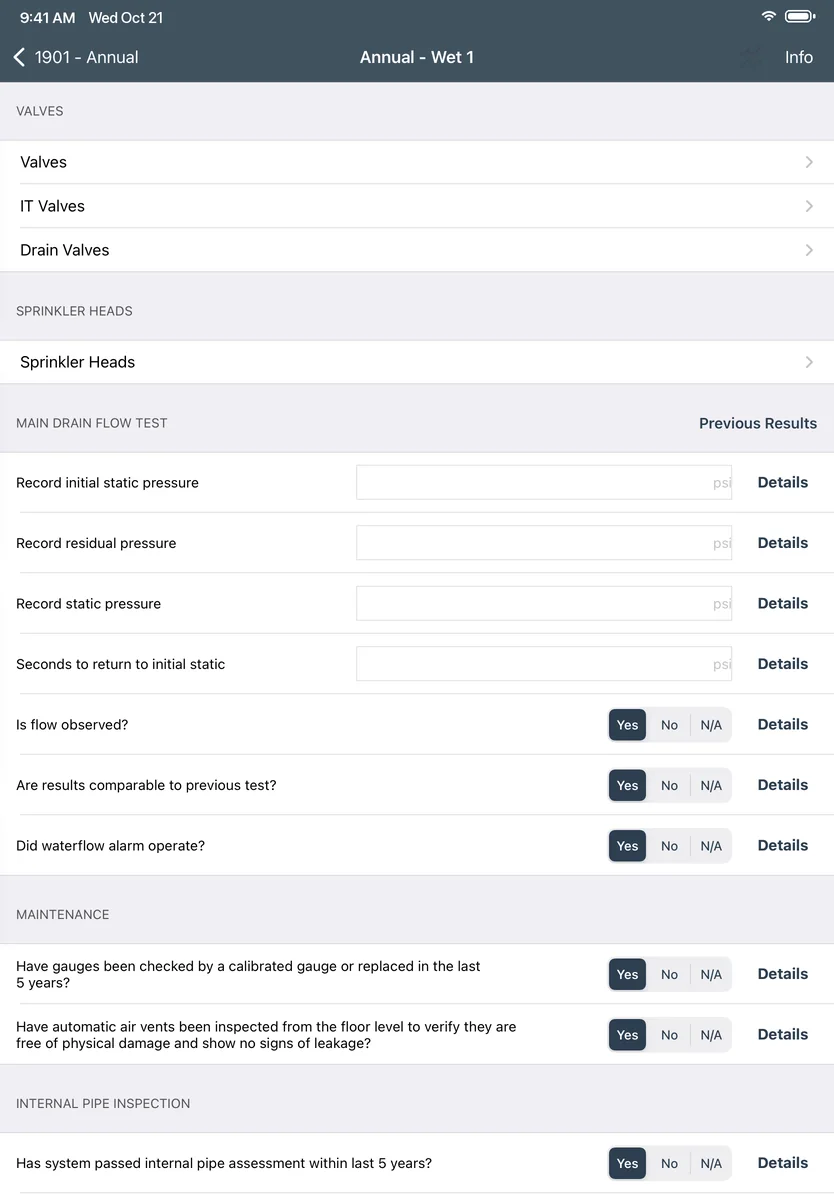
Same workflows, every territory. The industry’s largest code-aligned workflow library: NFPA, ULC, AES, Joint Commission, DNV, plus regional forms by jurisdiction. An acquired branch inherits your standard, not the other way around.
One data model
Buildings, systems, assets, deficiencies. Structured records down to the component, identical across every brand you own, so the numbers mean the same thing everywhere.
One workflow
Inspection to deficiency to proposal to work order to invoice. One chain, and nothing is re-entered downstream.
Every system
Alarm, sprinkler, extinguisher, suppression, backflow, doors and dampers, special hazards. Not tied to one manufacturer or panel ecosystem, so one standard covers the whole portfolio.
Kept current
Our code experts maintain the question sets as editions and jurisdictional requirements change.
One picture, every branch
Forty branches cannot be managed by what they self-report. With one data model underneath all of them, leadership reads what the field recorded.
Branch roll-upMonth to date
| Branch | Inspections | Open deficiencies | Proposals out | Invoices paid |
|---|---|---|---|---|
| Northeast | 312 | 41 | $86K | $210K |
| Southeast | 268 | 67 | $112K | $174K |
| Midwest | 195 | 28 | $54K | $141K |
| Acquired · week 3 | 44 | 19 | $12K | $9K |
Illustrative figuresThe same records the field wrote, rolled up
AI with governance built in.
The Inspect Point Assistant works on your live operational data, inside the product. Demos are easy. The real question is what happens when it can change your records.
AskAnswers from your data
Deficiencies, revenue, overdue inspections. No exports, no waiting on reports.
DoBulk operations in one sentence
With a confirmation step before anything runs.
UndoA 30-minute undo window on bulk actions
Delegation you can reverse.
Illustrative conversation
You don’t rip out the ERP to fix the field.
Field software that does not talk to the back office is another silo. So split the labor: your system of record still runs the business, and Inspect Point becomes the inspection layer.
The system of record stays
Scheduling and dispatch, customer and contract records, service workflow, invoicing, and billing. Whatever runs it today keeps running it, whether that is an ERP, an accounting system, or a service platform.
Inspections run in Inspect Point
Question logic by code year and jurisdiction, the technician’s experience on the truck, asset and deficiency data, and compliance submission to the portals your AHJs check.
First platform with native integrations to all three major AHJ compliance portals. Reports and deficiencies sync to TCE, IROL, and LivSafe.

IntegrationsAll partners →
QuickBooks Online and Desktop · Sage 100 Contractor · Vista by Viewpoint · Microsoft Dynamics 365 · Odoo · Q360
The Compliance Engine · IROL · LivSafe · FDNY native PFE tags · Dyne Fire Protection Labs
Salesforce · Zapier incl. Zoho · Inspect Point Payments · Inspect Point Fleet by Azuga · Socket Mobile barcodes
SOC 2 Type II, encrypted in transit and at rest, full export on the way out.
Security posture
SOC 2 Type II and GDPR-aligned practices. What your security review expects from the software holding your inspection record.
Your data stays yours
Your data comes in at onboarding and leaves with you if you go. A full export, on the way out.
AI boundaries
Your content is not used to train public models. Bulk actions preview first and can be undone for 30 minutes.
The specSecurity review
| Attestation | SOC 2 Type II |
|---|---|
| Practices | GDPR-aligned |
| Encryption | In transit · at rest |
| Access | You control who sees what |
| Export | Full, on request |
| Model training | Your content excluded |
| Undo window | 30 minutes |
Build it, stretch the ERP, or let every branch keep its own tools.
Build it in-house
Your IT team is good. But a field inspection platform is a product, not a project: question sets for every code year, offline mode, AHJ portal sync, an app store presence. It ends up as maintaining software on top of running a fire protection business.
Stretch the ERP’s field module
The ERP is excellent at what it does. Running field inspections to code was never part of that. Keep it. Give the field a system built for the work, and integrate the two.
Let every branch keep its own tools
Spreadsheets, PDFs, and whatever software came with the acquisition. It works, until you need portfolio-level answers, a compliance posture you can defend, or a clean diligence story. Fragmentation is a cost that compounds.
The questions your ops team will ask.
Do inspections work offline?
Which codes and standards are covered?
Do you support Canadian operations and ULC?
Bring the acquisition that closes next quarter.
The messy org chart, the branch still on paper, the deal in diligence. That is the walkthrough we want to do. If you are mid-acquisition, the standardization window is open right now.
What it is
A working session on your branch structure and workflows, live in the platform. Bring your branch list and the systems each one runs; you leave with the shape of your rollout: what moves first and where the integration seams fall.
Who you will talk to
The enterprise team. People who have run multi-branch rollouts before, backed by a support team that knows fire protection.
Not your call alone?
It rarely is. Send this page to your ops lead or IT, and bring them.