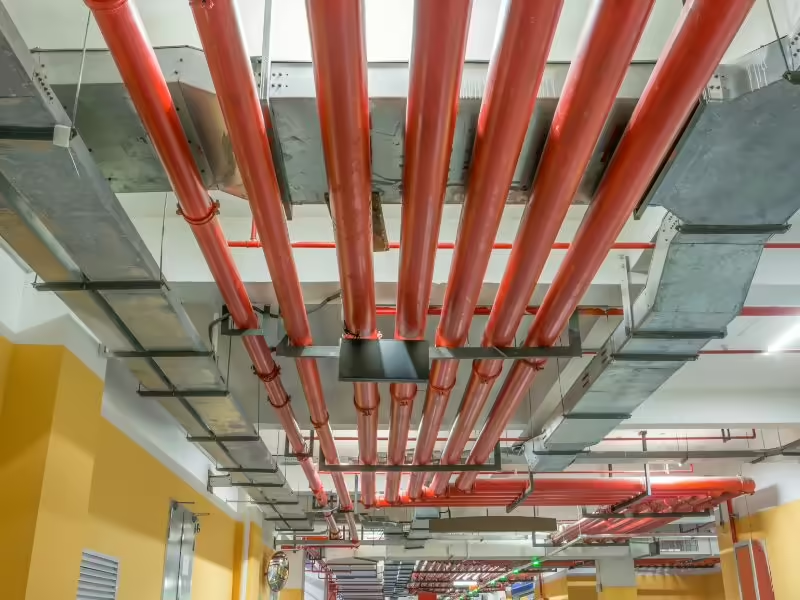
NFPA's fire loss estimates for 2022 put the toll at about 3,800 civilian deaths and $18 billion in property damage in the United States. Fire safety inspections are the routine work that keeps those numbers from being higher: the scheduled look at a building's fire protection systems and its fire hazards, by the people whose job is to find what is wrong before a fire does. This guide covers what a fire safety inspection is, who performs the two kinds, what each one includes, how often the systems in a building have to be inspected, the deficiencies that show up most, and how to prepare for the next one.
What is a fire safety inspection?
A fire safety inspection evaluates a building's fire protection systems and its fire hazards against the adopted code and standards. Two different inspections carry that name, and a building needs both. The fire department's inspection, by a fire inspector from the fire marshal's office, checks the building against the fire code: exits, storage, hazards, and whether the systems have their current inspection records. The contractor's inspection, by a licensed fire protection contractor, tests the systems themselves against the NFPA standards on the intervals those standards set, and produces the records the fire inspector asks for. The fire department versus contractor inspection article covers the split in detail.
What fire safety inspections include
| Area | The fire inspector checks | The contractor tests |
|---|---|---|
| Fire alarm | Panel shows normal, no troubles or silenced alarms, current inspection tag | Every initiating and notification device on its NFPA 72 interval |
| Sprinklers and standpipes | Control valves open and supervised, spare heads, no storage within 18 inches of heads, current tag | Gauges, valves, alarms, main drain, heads, pumps, and internal piping on NFPA 25 intervals |
| Extinguishers | Present, accessible, tagged within the year, mounted correctly | Annual maintenance, internal examination, hydrostatic test under NFPA 10 |
| Kitchen suppression | Current semiannual tag, hood clean, Class K extinguisher present | Semiannual service under NFPA 17A; cleaning under NFPA 96 |
| Fire doors and rated construction | Doors close and latch, not propped, no unsealed penetrations | Annual fire door inspection under NFPA 80 |
| Means of egress | Exits unlocked and clear, exit signs lit, emergency lighting works, occupant load posted | Monthly and annual emergency lighting tests under NFPA 101 |
| Hazards and housekeeping | Storage, flammable liquids, extension cords, electrical panels clear, hot-work permits, address visible | Not in scope |
How often
The fire department's schedule is set by the jurisdiction and the occupancy: annual is common for commercial buildings, more often for assembly, schools, and healthcare, and less for small low-risk businesses. The contractor's schedule is set by the standards, system by system.
| System | Baseline interval | Requirements |
|---|---|---|
| Fire alarm | Semiannual visual, annual functional, by component | NFPA 72 |
| Sprinklers | Weekly to five-year tasks; annual inspection | NFPA 25 |
| Fire pumps | Weekly or monthly churn; annual flow test | NFPA 25 Chapter 8 |
| Extinguishers | Monthly inspection; annual maintenance | NFPA 10 |
| Kitchen hoods | Semiannual service; cleaning by cooking volume | NFPA 96 and 17A |
| Fire doors | Annual | NFPA 80 |
| Emergency lighting and exit signs | Monthly 30-second; annual 90-minute | NFPA 101 |
Common fire protection deficiencies
The same findings turn up on inspection reports year after year, because they are things that happen to a building in use rather than construction defects: a fire door propped open with a wedge, storage stacked within 18 inches of sprinkler heads, sprinkler heads painted over or loaded with dust, a control valve closed for a repair and never reopened, extinguishers with an expired tag or none, an exit sign dark, emergency lights that pass the 30-second test and fail the 90-minute one, a fire alarm panel in trouble with the beeper silenced, extension cords as permanent wiring, an electrical panel blocked by storage, and a kitchen hood past its cleaning interval. Each has a fix that costs less than the citation, and most are found by walking the building between inspections.
What happens after
The fire inspector leaves a notice listing violations with a correction deadline and a re-inspection date; repeat violations bring fines, and dangerous conditions can bring an order to vacate. The contractor's report lists each finding with its severity, and under NFPA 25 that severity is one of three classes, noncritical, critical, or impairment, each with its own consequence; the deficiencies and impairments article covers them. Both reports are records the owner keeps and the next inspector reads.
Preparing for a fire safety inspection
- Pull the contractor's inspection reports for every system and confirm none has lapsed.
- Walk every exit path from the farthest point to the outside, opening each door.
- Test the exit signs and emergency lights, and look at the fire alarm panel.
- Check extinguisher tags and mounting, and the 18-inch clearance below sprinkler heads.
- Clear storage from electrical rooms, corridors, and stair enclosures, and look for extension cords doing permanent duty.
- Have the fire protection contractor's contact and the last reports where the inspector can see them.
Streamlining the contractor's side
For the contractor, the inspection is a form with hundreds of questions per building, and the report is what the fire inspector and the owner read. Inspect Point carries the question sets by system and code year, records deficiencies with photos and severity in the field, and produces the report the same day, so the record the fire inspector asks for exists before they ask. The inspections feature page shows the forms.
See Inspect Point run on your own inspections. A 30-minute demo, no commitment.