The Inspection Intelligence Report
Digitizedpaperwork isstill paperwork.
Inspection intelligence means every answer a technician records is saved as its own record, tied to the asset it describes, instead of flattened into a PDF. This free report from Inspect Point explains why that choice decides what you can ask of your own inspection history, and where your shop sits on the six stages between paper and a database.
Get the report.
Free, 23 pages. Submit and the download is one click away.
An Inspect Point report · 2026Trusted by 16,000+ fire protection professionals
- The six stages between a clipboard and a database, and how to tell which one your shop is on
- The five places form-based software breaks a business, with the structured data answer to each
- Four questions real customers asked of their inspection records, and what came back
How the report opens
“The fire protection industry replaced paper forms with digital ones and called it progress. But a digitized form is still a form: the data goes in, gets flattened into a PDF, and stops being useful. In fact, if your inspection platform advertises 1,000+ form templates, it’s advertising a problem, not a solution. Every template is a version of complexity the system can’t resolve on its own.”
Section 1 · The short version · Page 2 of 23
The rest of that section, and the other seven, are in the PDF. Get the report.
From sections 6 and 7
Questions that used to be projects
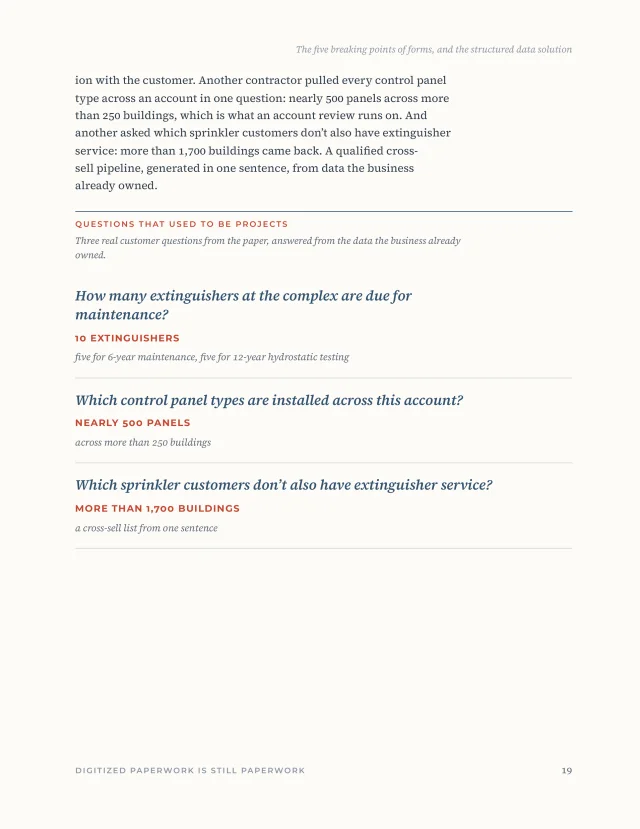
Four questions real customers asked Inspect Point Assistant, answered from inspection data the business already owned. Three of them used to take exports and spreadsheets. The fourth could not be asked at all.
How many extinguishers at the complex are due for maintenance?
10
Five for 6-year maintenance, five for 12-year hydrostatic testing. Next year’s code-mandated work, booked this year.Report, pp. 18 to 19
Which control panel types are installed across this account?
Nearly500
Panels across more than 250 buildings, which is what an account review runs on.Report, p. 19
Which sprinkler customers don’t also have extinguisher service?
More than1,700
Buildings came back. A qualified cross-sell list, from one sentence.Report, p. 19
Are there inspections where the notes say a repair was needed, but no deficiency was created?
Over200
Inspections flagged because the notes mentioned a repair and no deficiency record was created. Some will turn out to be false positives. Form-based software can’t ask this one at all.Report, pp. 20 to 21
Source: Digitized Paperwork Is Still Paperwork, sections 6 and 7 · Customer queries run in Inspect Point Assistant
The report walks through each question and how the data was set up to answer it. Get the report.
From section 3 · The spectrum at a glance
Six stages between a clipboard and a database
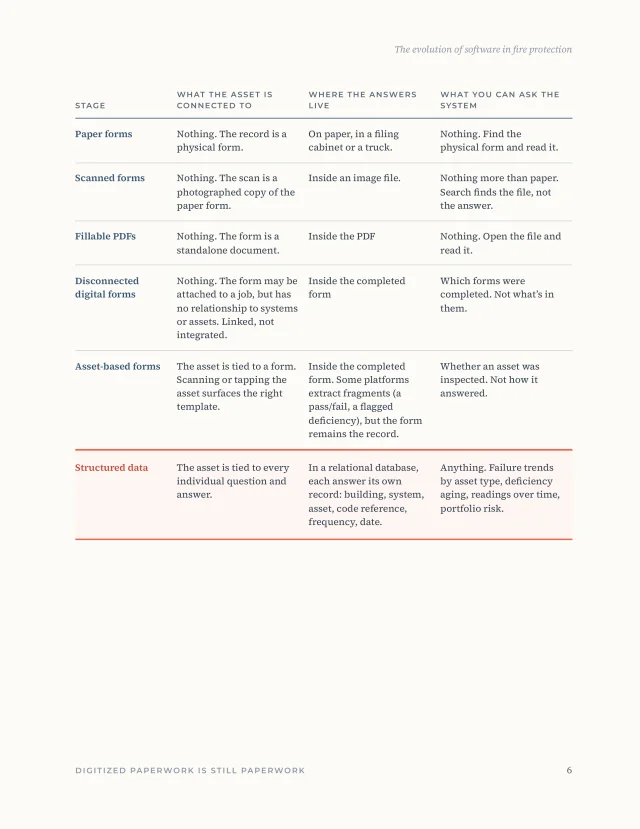
This is the report’s own table. Which row sounds like your shop? Pick it and you’ll get a short read on what the report says about that stage. You can get the report without picking.
| Stage | What the asset is connected to | Where the answers live | What you can ask the system |
|---|---|---|---|
| Nothing. The record is a physical form. | On paper, in a filing cabinet or a truck. | Nothing. Find the physical form and read it. | |
| Nothing. The scan is a photographed copy of the paper form. | Inside an image file. | Nothing more than paper. Search finds the file, not the answer. | |
| Nothing. The form is a standalone document. | Inside the PDF | Nothing. Open the file and read it. | |
| Nothing. The form may be attached to a job, but has no relationship to systems or assets. Linked, not integrated. | Inside the completed form | Which forms were completed. Not what’s in them. | |
| The asset is tied to a form. Scanning or tapping the asset surfaces the right template. | Inside the completed form. Some platforms extract fragments (a pass/fail, a flagged deficiency), but the form remains the record. | Whether an asset was inspected. Not how it answered. | |
| The asset is tied to every individual question and answer. | In a relational database, each answer its own record: building, system, asset, code reference, frequency, date. | Anything. Failure trends by asset type, deficiency aging, readings over time, portfolio risk. |
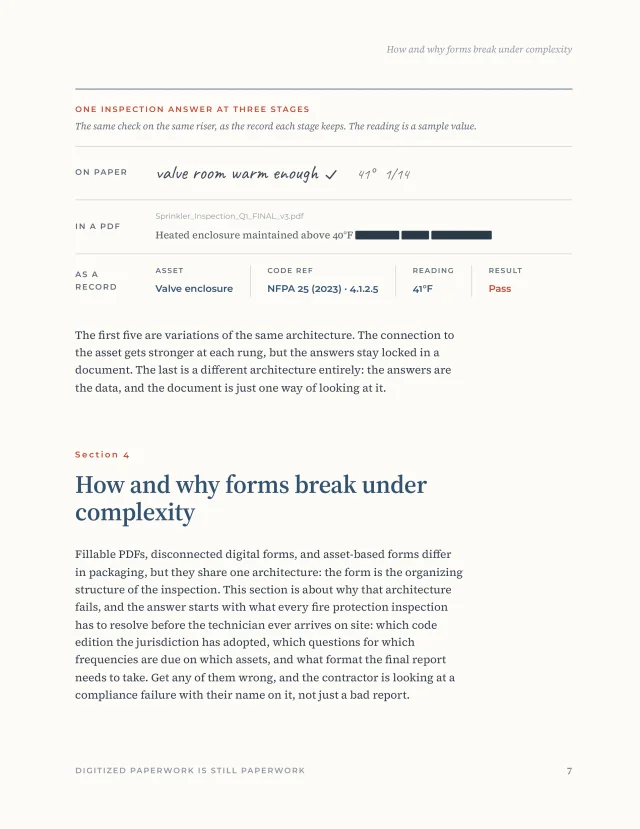
From section 3 · One inspection answer at three stages
Where one inspection answer ends up
A technician reads the temperature in a sprinkler valve enclosure, a real NFPA 25 check. Here is the same answer kept three ways.
One answerRiverside Medical Plaza · Wet pipe · riser 2
Stage onePen and paper
Written once. Filed in a cabinet. Read never again.
Stage twoDigital forms
The clipboard got a screen, and that’s real progress. But the answer got flattened into a file. Same filing cabinet, new font.
Stage threeInspection intelligence
The same answer, saved as a record: tied to the asset it describes and the code year it was inspected against. Queryable forever.
Which enclosures dropped below 40°F this winter?
Answered from the records, in one query. Ten years of PDFs can’t answer that.
What’s inside
- 01The short versionp. 2
- 02Introductionp. 3
- 03The evolution of software in fire protectionp. 4
- 04How and why forms break under complexityp. 7
- 05The structured data differencep. 10
- 06The five breaking points of formsp. 14
- 07The foundation for AI, and what comes afterp. 20
- 08The bottom linep. 22
About the report
Is inspection intelligence a rebrand of AI?
No. You and your business are intelligent without artificial intelligence. Inspection intelligence is about the data layer: structured, reusable inspection records instead of static documents. AI tools are only as useful as the data underneath them, which is exactly why the data layer comes first.
We already use digital forms. Is that the same thing?
Digital forms move the clipboard to a tablet, and that’s real progress. But the output is still a flat document. Inspection intelligence means each answer is stored as data tied to an asset, a code year, and a frequency, so it can be reused: reports, proposals, service history, trends.
What’s in the report?
The evolution from paper to structured data, the five variables that make fire inspections complex, the five breaking points of form-based software, what structured data changes in the field and the office, and what it means for AI. Twenty-three pages.
What does the report say about AI?
Section 7. An assistant on top of PDFs can read documents. An assistant on top of records can answer questions about your buildings, systems, and assets over time, and the report shows real examples. In the report’s words: “A platform bolting a chat interface onto a form-based system is reading documents. Inspect Point is querying a database.”
What does the report cost?
Nothing. Fill out the form, then open the PDF on the next page.
Do I need to be an Inspect Point customer to use it?
No. The framework applies to any fire protection operation, whatever software you run.
Free report · 23 pages
Get the report.
Why digitized paperwork is still paperwork, and what changes once every answer is stored as a record.
“Saved us hours, took the paper off our back counter, and increased proposals accepted by 40%.”Wendy Griepentrog · Inspection and Service Manager, HJ Pertzborn Plumbing & Fire Protection